The Future Is Now: What Level 3 AI Looks Like for SMBs
There is a lot of noise around AI right now. Every week brings another announcement about a new model, agent, platform or breakthrough. For an SMB owner, it can be difficult to separate what is genuinely useful from what is simply the latest technology headline.
What I find more interesting is what is happening inside companies that took a more deliberate approach. They didn’t start by asking, “What can we do with AI?” They started by asking, “What are we trying to accomplish, and where can AI help us do it better?” Those companies are now beginning to see measurable benefits from what I would call Level 3 AI.
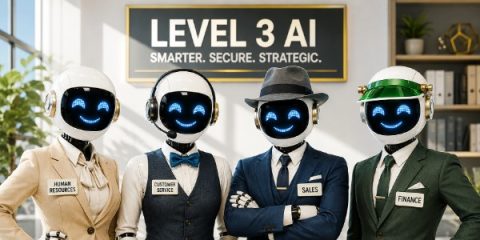
We are seeing those opportunities across Human Resources, Customer Service, Sales & Marketing, Finance and Compliance. These aren’t futuristic possibilities. Companies are already using AI to support real workflows, automate repetitive work, identify patterns and give people better information for making decisions. The important point is that they didn’t jump directly to Level 3.
The Journey Matters
The path starts with strategy. Before introducing advanced AI into business processes, an organization needs to understand what it wants AI to accomplish, what information it can safely access and where human judgment needs to remain part of the process. That means establishing guardrails for acceptable AI use, implementing appropriate security controls, protecting sensitive information and choosing business priorities rather than trying to automate everything at once.
From there, the progression is logical. Level 1 might begin with individual productivity: drafting an email, summarizing a document, researching a topic or creating content. Level 2 starts connecting AI to business processes and workflows. At Level 3, AI becomes more deeply integrated into the business, using data, automation and increasingly predictive capabilities to help accomplish defined business goals.
Measurement is critical throughout that journey. If we can’t demonstrate that an AI implementation is saving time, improving service, reducing errors, increasing sales opportunities, reducing risk or producing some other meaningful business outcome, why are we doing it?
At KL Tech, we’re following the same path ourselves. As we look for opportunities to automate our own business processes, we’re asking the same questions we ask our clients: What is the business objective? What are the risks? Where should AI be involved? How will we measure the result? Most importantly, we’re not interested in making something simply faster or cheaper if it creates a worse experience. The goal is to make the experience better for our clients, our employees and our business.
What Level 3 Looks Like Today
Human Resources: AI can help employees find answers about benefits, policies and procedures, assist with recruiting and candidate research, support onboarding and automate routine HR administration. Employees get faster access to information while HR teams and managers can focus on higher-value work.
Customer Service: AI can categorize and route requests, provide answers from an approved knowledge base, summarize customer history, suggest responses and identify issues requiring human escalation. It can also analyze recurring questions and complaints to uncover opportunities to improve the customer experience.
Sales & Marketing: AI can research prospects, prioritize leads, personalize outreach, automate follow-up and identify buying signals. It can analyze campaign performance and help sales teams focus their attention where the probability of success is highest, giving an SMB the kind of leverage that once required a much larger team.
Finance & Compliance: AI can analyze financial information, identify anomalies and trends, assist with forecasting and flag exceptions that deserve attention. It can also automate recurring compliance checks, documentation reviews, reminders and reporting. The goal isn’t to have AI make financial or compliance decisions. It’s to give the people responsible for those decisions better information, sooner.
These are just some of the areas where Level 3 capabilities are beginning to deliver value. There are many more opportunities, but the common denominator is simple: the business process comes first and the technology follows.
Don’t Skip the Foundation
This is the part I think gets lost in the AI conversation. An SMB can absolutely move toward advanced AI. The technology is increasingly accessible and the opportunities are already here, but you can’t skip the fundamentals and expect advanced AI to produce sustainable results.
You need a strategy that connects AI to business objectives, guardrails that establish how it can be used, security that protects your information, and priorities that determine where to begin. Then you need to measure the results, learn from them and use that experience to advance to the next opportunity. That’s how AI moves from experimentation to meaningful adoption.
The future isn’t waiting for some distant technological breakthrough. It’s already showing up in businesses that have built the foundation for it.
It’s not too late to develop your AI strategy. There is still an enormous opportunity for SMBs to get started, learn and build a meaningful advantage. But don’t assume your competitors are waiting.
The future is now. The question is whether you’ll have a strategy to take advantage of it.